
Describing Motion Around Us
Learning Objectives
- Describe the position of an object using a reference point and direction.
- Differentiate between distance travelled and displacement.
- Differentiate between average speed and average velocity, and calculate average acceleration.
- Interpret and draw position–time and velocity–time graphs, and extract physical quantities (velocity from slope, displacement from area) from them.
- Derive and apply the three kinematic equations for motion with constant acceleration.
- Understand uniform circular motion and explain why it is an accelerated motion even though speed is constant.
Section 1: Important Competency-Based Questions
1 (MCQ)
A cyclist rides 300 m east and then 300 m west back to the starting point in 5 minutes. What is the displacement and distance travelled?
Options: (a) Displacement = 600 m, Distance = 600 m
(b) Displacement = 0 m, Distance = 600 m
(c) Displacement = 0 m, Distance = 0 m
(d) Displacement = 600 m, Distance = 0 m
Answer: (b) Displacement = 0 m, Distance = 600 m
Explanation: Distance travelled is the total path length covered, regardless of direction: 300 m + 300 m = 600 m. Displacement is the net change in position between initial and final points. Since the cyclist returns to the starting point, the initial and final positions coincide, so displacement = 0 m.
Concept Tested: Distance vs displacement
2 (Assertion–Reason)
Assertion (A): A car moving on a circular track at a constant speedometer reading of 40 km/h is said to be accelerating. Reason (R): Acceleration occurs only when the magnitude of velocity changes.
Options: (a) Both A and R are true, and R is the correct explanation of A. (b) Both A and R are true, but R is NOT the correct explanation of A. (c) A is true, but R is false. (d) A is false, but R is true.
Answer: (c) A is true, but R is false.
Explanation: A car on a circular track has continuously changing direction of velocity even though its speed (magnitude) stays constant. Since velocity is a vector requiring both magnitude and direction, any change in direction alone means the velocity is changing, and hence the car is accelerating. So A is true. R is false because acceleration can also result from a change in direction alone, not just magnitude.
Concept Tested: Acceleration in uniform circular motion
3 (Case-Based)
An athlete starts running from point O (t = 0 s), reaches point A at 100 m (t = 10 s), and then runs back to point B at 40 m (t = 16 s), along the same straight track.
(a) Find the total distance travelled between t = 0 s and t = 16 s. (b) Find the displacement between t = 0 s and t = 16 s. (c) Find the average speed and average velocity for this interval.
Answer: (a) Total distance = OA + AB = 100 m + 60 m = 160 m (b) Displacement = OB = 40 m (in the positive direction, since B is to the right of O) (c) Average speed = 160 m / 16 s = 10 m/s Average velocity = 40 m / 16 s = 2.5 m/s (positive direction)
Explanation: Distance adds up every metre covered in both directions (100 m forward + 60 m backward), while displacement only considers the net change from the starting point O to the final point B. Average speed uses total distance; average velocity uses displacement — hence they differ here since the athlete reversed direction.
Concept Tested: Distance, displacement, average speed, average velocity in a real motion scenario
4 (MCQ)
The position–time graph of an object is a straight line inclined to the time axis. What does this indicate?
Options: (a) The object is at rest. (b) The object is moving with increasing speed. (c) The object is moving with constant velocity. (d) The object is moving with constant acceleration but zero initial velocity.
Answer: (c) The object is moving with constant velocity.
Explanation: The slope of a position–time graph gives velocity. A straight line has a constant slope, which means the velocity does not change with time — the object is in uniform motion. A curved position-time graph, not a straight one, would indicate acceleration.
Concept Tested: Interpretation of position-time graphs
5 (Diagram/Situation-Based)
A velocity–time graph shows a straight line rising from 5 m/s at t = 0 s to 25 m/s at t = 10 s.
(a) Calculate the acceleration. (b) Calculate the displacement in this interval.
Answer: (a) a = (v − u)/t = (25 − 5)/10 = 2 m/s² (b) Displacement = area under the graph (trapezium) = ½ × (u + v) × t = ½ × (5 + 25) × 10 = 150 m
Explanation: The slope of a velocity–time graph gives acceleration, while the area enclosed between the graph line and the time axis gives displacement. Here the shape between t = 0 and t = 10 s is a trapezium with parallel sides 5 m/s and 25 m/s and height (time) 10 s.
Concept Tested: Slope and area under a velocity-time graph
6 (Short Analytical)
Two cars start from rest at the same point and move in the same direction. Car P has a higher acceleration than Car Q. After some time, will the position–time graphs of P and Q ever intersect (other than at t = 0)? Justify.
Answer: No, since both start from rest at the same point and Car P always has greater acceleration (hence always higher velocity for t > 0), Car P’s position will always be ahead of Car Q’s for all t > 0. The graphs will not intersect again.
Explanation: Since acceleration determines how quickly velocity (and hence position) increases, a car with consistently higher acceleration will always be farther ahead after leaving the same starting point at the same time. The position-time curves diverge continuously; they do not cross again.
Concept Tested: Comparing motion of two objects using graphs
7 (Case-Based)
Think It Over (Chapter opener): A driver wants to know how much distance to maintain from the truck ahead to avoid a collision if the truck suddenly brakes.
A car moving at 20 m/s has a reaction time of 0.5 s before the brakes are applied. Once applied, the brakes produce a deceleration of 5 m/s².
(a) Find the distance covered during the reaction time. (b) Find the braking distance after the brakes are applied. (c) Find the total (safe) stopping distance.
Answer: (a) Distance during reaction time = v × t = 20 × 0.5 = 10 m (b) Using v² = u² + 2as: 0 = (20)² + 2(−5)s ⇒ s = 400/10 = 40 m (c) Total stopping distance = 10 + 40 = 50 m
Explanation: The total distance a vehicle needs to stop safely has two parts: the distance covered during the driver’s reaction time (before brakes are applied, at constant velocity), and the braking distance (after brakes are applied, under deceleration). This is why the safe following distance must increase at higher speeds — since braking distance depends on u² (from the kinematic equation), doubling speed quadruples the braking distance.
Concept Tested: Kinematic equations applied to real-life stopping distance; reasoning about speed dependence
8 (Assertion–Reason)
Assertion (A): A bus moving at a constant velocity of 60 km/h has zero acceleration. Reason (R): Acceleration depends on how fast an object is moving.
Options: (a) Both A and R are true, and R is the correct explanation of A. (b) Both A and R are true, but R is NOT the correct explanation of A. (c) A is true, but R is false. (d) A is false, but R is true.
Answer: (c) A is true, but R is false.
Explanation: A is correct: since the velocity (both magnitude and direction) does not change, the acceleration is zero, regardless of how high the speed itself is. R is incorrect: acceleration depends on how quickly the velocity changes with time, not on how fast the object is moving. An object can move very fast with zero acceleration (constant velocity) or move slowly while accelerating rapidly.
Concept Tested: Distinction between speed and acceleration
9 (MCQ)
A ball is dropped from a height and falls freely under gravity. Its velocity at successive one-second intervals is 0, 9.8, 19.6, 29.4 m/s. What can you conclude?
Options: (a) The ball has non-uniform acceleration. (b) The ball has uniform acceleration of 9.8 m/s². (c) The ball’s average speed is constant. (d) The displacement in each second is equal.
Answer: (b) The ball has uniform acceleration of 9.8 m/s².
Explanation: The increase in velocity in every successive one-second interval is exactly 9.8 m/s, showing that the average acceleration is the same (constant) across all intervals — this is the acceleration due to gravity, g. Since velocity keeps increasing, displacement in each second is not equal (it increases), ruling out (d).
Concept Tested: Constant/uniform acceleration; acceleration due to gravity
10 (Situation-Based)
Two objects A and B move in a straight line, starting from the same position at t = 0. Object A moves with constant velocity, while object B starts from rest and accelerates uniformly. Their position–time graphs meet again at t = 10 s. Which object had the higher average speed between 0 and 10 s? Which one had a higher instantaneous speed at t = 10 s?
Answer: Both A and B have the same average speed over 0–10 s, since they cover the same displacement (they meet at the same position) in the same time. However, at t = 10 s, object B (the accelerating one) has a higher instantaneous speed, since it started slower but kept speeding up to “catch up” to A by t = 10 s — meaning its speed at the end must exceed A’s constant speed.
Explanation: Average speed only depends on total distance and total time, so if both cover equal distance in equal time, their average speeds are equal — even though their motions look very different. This distinguishes average speed (a summary quantity) from instantaneous speed (value at one moment).
Concept Tested: Average vs instantaneous speed; graphical reasoning
11 (Assertion–Reason)
Assertion (A): Fuel consumption in a vehicle depends on the total distance travelled, not on displacement. Reason (R): The engine of a vehicle does work against friction and resistance throughout the actual path covered, irrespective of the net change in position.
Options: (a) Both A and R are true, and R is the correct explanation of A. (b) Both A and R are true, but R is NOT the correct explanation of A. (c) A is true, but R is false. (d) A is false, but R is true.
Answer: (a) Both A and R are true, and R is the correct explanation of A.
Explanation: A vehicle that travels 100 km forward and 100 km back to its starting point has zero displacement but has still consumed fuel for the entire 200 km journey, because the engine works continuously against friction/air resistance over the whole path length — not just the net displacement.
Concept Tested: Real-world application of distance vs displacement
12 (Case-Based)
A ball is thrown vertically upward from point O. It rises to point B and falls back to O. Positions A and C are on the way up and down respectively, both 40 cm above O (i.e., A and C represent the same 40 cm mark on the path).
(a) Is the total distance travelled equal to the magnitude of displacement between O and C? (b) What is the displacement of the ball when it returns to O?
Answer: (a) No. Even though A and C are at the same position (40 cm above O), the total distance travelled up to reaching C (going up to B and coming back down to the 40 cm mark) is greater than the straight-line displacement from O to C (40 cm), because the ball’s path included the additional upward journey to B and part of the way back. (b) When the ball returns to O, displacement = 0, even though total distance travelled = 2 × OB (up and down).
Explanation: This is the same reasoning explored in Activity 4.1 of the chapter: whenever an object reverses direction, the total distance travelled exceeds the magnitude of displacement. The two are equal only when the object moves without turning back.
Concept Tested: Distance vs displacement in motion with reversal of direction (vertical motion)
13 (MCQ)
Which of the following statements about uniform motion is correct?
Options: (a) The object covers equal distances in equal intervals of time only sometimes. (b) The object covers equal distances in equal intervals of time, for any choice of time interval. (c) The object’s speed keeps increasing steadily. (d) The object’s acceleration is always non-zero.
Answer: (b) The object covers equal distances in equal intervals of time, for any choice of time interval.
Explanation: This is the defining condition of uniform motion in a straight line — equal distances in equal time intervals, for every possible choice of interval, which corresponds to constant speed and zero acceleration.
Concept Tested: Definition of uniform motion
(Diagram-Based)
A stone is whirled in a horizontal circle at the end of a string. If the string suddenly breaks when the stone is at the eastern-most point of the circle and moving northward, in what direction will the stone fly off?
Answer: The stone will fly off in a straight line towards the north — i.e., along the tangent to the circle at that point, in the direction it was moving at the instant the string broke.
Explanation: In circular motion, the instantaneous velocity at any point is always directed along the tangent to the circle at that point. Once the centripetal constraint (the string) is removed, there is nothing to keep the object moving in a curve, so it continues in a straight line in the direction of its velocity at that instant — exactly as demonstrated by the marble-and-ring activity in the chapter.
Concept Tested: Direction of velocity in circular motion (tangent to the circle)
15 (Short Analytical)
Explain, with reasoning, why an object undergoing uniform circular motion is said to be “accelerating” even though its speed never changes.
Answer: Acceleration is the rate of change of velocity, and velocity is a vector — it has both magnitude (speed) and direction. In uniform circular motion, the speed remains constant, but the direction of the velocity keeps changing continuously as the object moves around the circle (velocity is always tangential). Since the direction of velocity is continuously changing, the velocity itself is changing, and therefore the object has a non-zero acceleration — even though its speed is unchanged.
Explanation: This tests the common misconception that acceleration only means “speeding up.” Any change in velocity — in magnitude, direction, or both — counts as acceleration.
Concept Tested: Acceleration as a vector rate of change; uniform circular motion
16 (Assertion–Reason)
Assertion (A): The magnitude of displacement of an athlete running one full lap of a circular track is zero. Reason (R): The total distance travelled by the athlete over one full lap equals the circumference of the track.
Options: (a) Both A and R are true, and R is the correct explanation of A. (b) Both A and R are true, but R is NOT the correct explanation of A. (c) A is true, but R is false. (d) A is false, but R is true.
Answer: (b) Both A and R are true, but R is NOT the correct explanation of A.
Explanation: Both statements are individually correct: displacement after one complete lap is zero because the athlete returns to the starting point, and distance travelled in one lap does equal the circumference (2πR). However, R does not explain A — the reason displacement is zero is that the initial and final positions coincide, not because of the value of the distance travelled.
Concept Tested: Independent verification of distance and displacement facts in circular motion
17 (Case-Based)
A motorbike moving at 108 km/h applies brakes and comes to rest after travelling 150 m, under uniform deceleration.
(a) Convert the initial speed to m/s. (b) Find the acceleration (deceleration) of the motorbike. (c) Find the time taken to stop.
Answer: (a) u = 108 × (1000/3600) = 30 m/s (b) Using v² = u² + 2as: 0 = (30)² + 2a(150) ⇒ 0 = 900 + 300a ⇒ a = −3 m/s² (c) Using v = u + at: 0 = 30 + (−3)t ⇒ t = 10 s
Explanation: This question tests unit conversion (km/h to m/s), and correct application of two kinematic equations (v² = u² + 2as, and v = u + at) for a decelerating object, with careful attention to the negative sign of acceleration.
Concept Tested: Kinematic equations, unit conversion, deceleration
18 (MCQ)
The SI unit of average acceleration is:
Options: (a) m/s (b) m/s² (c) m (d) s
Answer: (b) m/s²
Explanation: Average acceleration = change in velocity ÷ time interval. Since velocity is measured in m/s and time in s, acceleration has units of (m/s)/s = m/s² (also written as m s⁻²).
Concept Tested: SI units in kinematics
19 (Short Analytical)
A car accelerates uniformly from 10 m/s to 30 m/s while covering a distance of 200 m. Find the acceleration and the time taken.
Answer: Using v² = u² + 2as: (30)² = (10)² + 2a(200) 900 = 100 + 400a a = 800/400 = 2 m/s²
Using v = u + at: 30 = 10 + 2t t = 10 s
Explanation: When displacement is given along with initial and final velocities, the third kinematic equation (v² = u² + 2as) is the most direct way to find acceleration without needing time first. Once acceleration is known, the first equation (v = u + at) gives the time.
Concept Tested: Application and correct selection of kinematic equations
20 (Assertion–Reason)
Assertion (A): For an object moving in a straight line without reversing its direction, the average speed and the magnitude of the average velocity over any time interval are equal. Reason (R): In such motion, the total distance travelled and the magnitude of displacement are equal.
Options: (a) Both A and R are true, and R is the correct explanation of A. (b) Both A and R are true, but R is NOT the correct explanation of A. (c) A is true, but R is false. (d) A is false, but R is true.
Answer: (a) Both A and R are true, and R is the correct explanation of A.
Explanation: Average speed = total distance/time, and average velocity magnitude = displacement/time. When motion is confined to one direction with no reversal, distance travelled and the magnitude of displacement become numerically equal (as noted in the chapter’s key note), and therefore average speed and the magnitude of average velocity must also be equal.
Concept Tested: Conditions under which speed equals velocity magnitude
Section 2: NCERT Exercise Solutions (Revise, Reflect, Refine)
1
Question: Father goes from home to a shop 250 m away, forgets a bag, returns home, goes to the shop again, buys provisions, and returns home. Find the total distance travelled and displacement from home.
Solution: Step 1: Home → Shop = 250 m Step 2: Shop → Home (to get the bag) = 250 m Step 3: Home → Shop (again) = 250 m Step 4: Shop → Home (final return) = 250 m Step 5: Total distance = 250 + 250 + 250 + 250 = 1000 m Step 6: Since he ends up back at home (his starting point), displacement = 0 m
Final Answer: Total distance travelled = 1000 m; Displacement = 0 m
2
Question: A student runs from the ground floor to the 4th floor (height of each floor = 3 m) and then comes down to the 2nd floor. Find (i) total vertical distance travelled, and (ii) displacement from the starting point.
Solution: Step 1: Ground floor to 4th floor = 4 × 3 m = 12 m (upward) Step 2: 4th floor to 2nd floor = 2 × 3 m = 6 m (downward) Step 3: Total vertical distance = 12 m + 6 m = 18 m Step 4: Final position (2nd floor) is 2 × 3 m = 6 m above the ground floor (starting point).
Final Answer: (i) Total distance = 18 m (ii) Displacement = 6 m, in the upward direction
3
Question: A girl’s scooter speedometer reading is constant. Can the scooter still be accelerating? If so, how?
Solution: Step 1: A constant speedometer reading means the speed (magnitude of velocity) is constant. Step 2: Velocity is a vector; it can change even if only the direction changes, while speed (magnitude) stays the same. Step 3: If the scooter is moving along a curved or circular path (e.g., turning a corner) at a constant speed, its direction of motion is continuously changing.
Final Answer: Yes, it is possible. If the scooter moves along a curved path at constant speed, its velocity changes direction continuously, so it is accelerating even though the speedometer reading (speed) stays constant.
4
Question: A car starts from rest and reaches 24 m/s in 6 s. Find the average acceleration and the distance travelled.
Solution: Step 1: Given u = 0 m/s, v = 24 m/s, t = 6 s Step 2: Average acceleration, a = (v − u)/t = (24 − 0)/6 = 4 m/s² Step 3: Distance: s = ut + ½at² = 0 + ½ × 4 × (6)² = ½ × 4 × 36 = 72 m Step 4 (check): Using v² = u² + 2as → (24)² = 0 + 2(4)s → s = 576/8 = 72 m ✓
Final Answer: Acceleration = 4 m/s²; Distance travelled = 72 m
5
Question: A motorbike with initial velocity 28 m/s and constant acceleration stops after travelling 98 m. Find the acceleration and time taken to stop.
Solution: Step 1: Given u = 28 m/s, v = 0 m/s, s = 98 m Step 2: Using v² = u² + 2as: 0 = (28)² + 2a(98) → 0 = 784 + 196a Step 3: a = −784/196 = −4 m/s² Step 4: Using v = u + at: 0 = 28 + (−4)t → t = 28/4 = 7 s
Final Answer: Acceleration = −4 m/s² (deceleration); Time taken = 7 s
6
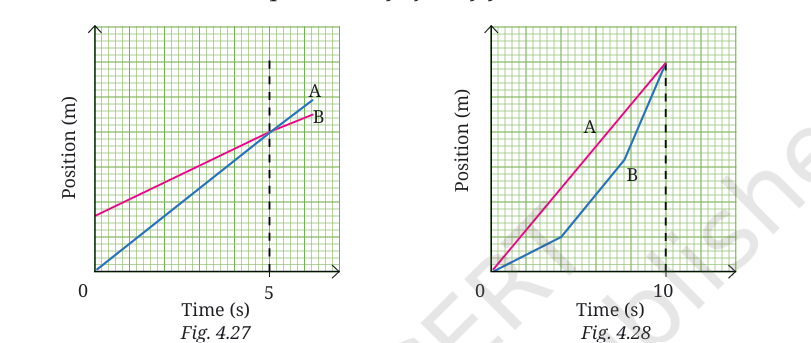
Question: Fig. 4.27 shows the position–time graph of two objects A and B moving along parallel tracks in the same direction, with their lines crossing near t = 5 s. Do A and B ever have equal velocity? Justify.
Solution: Step 1: On a position–time graph, velocity at any instant is represented by the slope of the graph at that point. Step 2: The two lines have different slopes wherever they are not parallel to each other; only where the two lines run parallel (same steepness) do the objects have equal velocity. Step 3: In Fig. 4.27, before the point where the lines meet, A and B approach each other with different (unequal) slopes; the lines meeting only means A and B are at the same position at that instant, not that they have the same velocity. Step 4: A and B have equal velocity only if, at some interval, both lines have identical slope (i.e., run parallel on the graph).
Final Answer: A and B have the same velocity only during the interval(s) where their position–time graph lines are parallel to each other (equal slope); the point where the two lines cross only indicates equal position at that instant, not equal velocity.
7
Question: Fig. 4.28 shows position vs time for objects A (straight line) and B (curved line), both starting at the same position at t = 0 and reaching the same final position at t = 10 s, without reversing direction. Choose the correct option(s): (i) Average velocities are equal (same initial/final positions) (ii) Average speeds are equal (equal distance in equal time) (iii) Average speed of A is lower than B’s (iv) Average speed of A is greater than B’s
Solution: Step 1: Since A and B start at the same position and end at the same position after 10 s, their displacement is identical → average velocity (displacement/time) is the same for both. Option (i) is correct. Step 2: Since neither A nor B reverses direction during the 10 s (both move only forward, based on the graph), the total distance travelled by each equals the magnitude of its displacement. Since both have equal displacement, both also have equal total distance travelled, and hence equal average speed. Option (ii) is correct. Step 3: Since average speeds are equal, options (iii) and (iv), which claim unequal average speeds, are incorrect.
Final Answer: Correct options: (i) and (ii)
8
Question: A truck driver at 54 km/h slows down to 36 km/h in 36 s. Find the distance travelled during this time (assume constant acceleration).
Solution: Step 1: Convert: u = 54 km/h = 15 m/s; v = 36 km/h = 10 m/s; t = 36 s Step 2: Since acceleration is constant, average velocity = (u + v)/2 = (15 + 10)/2 = 12.5 m/s Step 3: Distance, s = average velocity × time = 12.5 × 36 = 450 m Step 4 (check): a = (v − u)/t = (10 − 15)/36 = −5/36 m/s²; s = ut + ½at² = 15(36) + ½(−5/36)(36)² = 540 − 90 = 450 m ✓
Final Answer: Distance travelled = 450 m
9
Question: A car starts from rest, accelerates uniformly to 20 m/s in 5 s, travels at 20 m/s for 10 s, then brakes (uniform deceleration) to stop in 6 s. Find the total distance travelled.
Solution: Step 1 (Phase 1 — acceleration): u = 0, v = 20 m/s, t = 5 s s₁ = ½(u + v)t = ½(0 + 20)(5) = 50 m Step 2 (Phase 2 — constant velocity): v = 20 m/s, t = 10 s s₂ = v × t = 20 × 10 = 200 m Step 3 (Phase 3 — braking): u = 20 m/s, v = 0, t = 6 s s₃ = ½(u + v)t = ½(20 + 0)(6) = 60 m Step 4: Total distance = s₁ + s₂ + s₃ = 50 + 200 + 60 = 310 m
Final Answer: Total distance travelled = 310 m
10
Question: A bus travelling at 36 km/h sees an obstacle 30 m ahead. Reaction time = 0.5 s, then brakes with deceleration 2.5 m/s². Will the bus stop before reaching the obstacle?
Solution: Step 1: Convert: u = 36 km/h = 10 m/s Step 2 (during reaction time): Distance covered at constant velocity = u × t = 10 × 0.5 = 5 m Step 3: Distance remaining to obstacle = 30 − 5 = 25 m Step 4 (braking distance): Using v² = u² + 2as, with v = 0, u = 10 m/s, a = −2.5 m/s²: 0 = (10)² + 2(−2.5)s → 0 = 100 − 5s → s = 20 m Step 5: Compare braking distance (20 m) with remaining distance (25 m): 20 m < 25 m
Final Answer: Yes, the bus stops safely, with 5 m to spare before the obstacle.
11
Question: “The Earth moves around the Sun.” Discuss whether an object kept on the Earth can be considered to be at rest.
Solution: Step 1: Rest and motion are always described relative to a chosen reference point. Step 2: If the Earth’s surface is taken as the reference point, an object resting on the ground does not change its position with respect to the Earth — so it is “at rest” with respect to the Earth. Step 3: However, if the Sun is taken as the reference point, the same object is moving continuously (along with the Earth) around the Sun at high speed — so it is “in motion” with respect to the Sun.
Final Answer: Whether an object is at rest or in motion is relative — it depends on the reference point chosen. The object is at rest relative to the Earth but in motion relative to the Sun. There is no such thing as absolute rest.
12
Question: The velocity-time graph (0–120 s) for a cyclist (Fig. 4.30) rises from 0 to 3 m/s (0–20 s), stays constant at 3 m/s (20–100 s), then decreases to 2 m/s (100–120 s). Shade the regions for (i) constant velocity, (ii) decreasing velocity, and find total displacement and average acceleration over 120 s.
Solution: Step 1 (constant-velocity region): Shade the rectangle from t = 20 s to t = 100 s at height 3 m/s. Displacement = 3 × (100 − 20) = 3 × 80 = 240 m Step 2 (decreasing-velocity region): Shade the trapezium from t = 100 s to t = 120 s (velocity falling from 3 to 2 m/s). Displacement = ½(3 + 2)(20) = ½(5)(20) = 50 m Step 3 (accelerating region, 0–20 s): Displacement = ½(0 + 3)(20) = 30 m Step 4: Total displacement = 30 + 240 + 50 = 320 m Step 5 (average acceleration over 120 s): a = (v_final − v_initial)/t = (2 − 0)/120 ≈ 0.017 m/s²
Final Answer: Total displacement ≈ 320 m; Average acceleration ≈ 0.017 m/s² (readings approximate, based on graph values)
13
Question: Fig. 4.31 shows a girl’s running velocity (in km/h) vs time (in hours) during marathon training. Estimate the distance she ran.
Solution: Step 1: Since the graph is a curve (non-uniform velocity), the distance covered is found from the area under the velocity-time graph, estimated using approximate readings at each hour and the trapezoidal method. Step 2: Approximate hourly velocity readings from the graph: t=0→0, t=1→6.5, t=2→7.5, t=3→7.5, t=4→7, t=5→6, t=6→5 (km/h) Step 3: Distance in each 1-hour interval ≈ average of the two end velocities × 1 h: 0–1 h: 3.25 km, 1–2 h: 7.0 km, 2–3 h: 7.5 km, 3–4 h: 7.25 km, 4–5 h: 6.5 km, 5–6 h: 5.5 km Step 4: Total ≈ 3.25 + 7.0 + 7.5 + 7.25 + 6.5 + 5.5 = ≈ 37 km
Final Answer: Estimated distance ≈ 37 km (values depend on precise graph readings; the method — area under the v–t curve, estimated via trapezoidal approximation — is the key takeaway)
14
Question: A car moves at constant velocity 6 m/s for 2 minutes, then accelerates at 1 m/s² for 6 s. Find the displacement in the 2 min 6 s interval by drawing a velocity–time graph.
Solution: Step 1: Convert 2 minutes to seconds: 2 min = 120 s Step 2 (Phase 1 — constant velocity): s₁ = 6 × 120 = 720 m Step 3 (Phase 2 — acceleration): u = 6 m/s, a = 1 m/s², t = 6 s s₂ = ut + ½at² = 6(6) + ½(1)(36) = 36 + 18 = 54 m Step 4: Total displacement = 720 + 54 = 774 m Step 5 (graph description): The velocity–time graph is a horizontal line at 6 m/s from t = 0 to 120 s, followed by a straight line rising from 6 m/s to 12 m/s (since v = u + at = 6 + 1×6 = 12 m/s) between t = 120 s and t = 126 s.
Final Answer: Total displacement = 774 m
15
Question: Car A reaches 5 m/s in 5 s (from rest); Car B reaches 3 m/s in 10 s (from rest), both with constant acceleration. Plot velocity–time graphs and calculate displacement in each stated interval.
Solution: Step 1 (accelerations): aₐ = 5/5 = 1 m/s²; a_B = 3/10 = 0.3 m/s² Step 2 (velocity table for Car A, t = 0,1,2,3,4,5 s): v = 0, 1, 2, 3, 4, 5 m/s Step 3 (velocity table for Car B, t = 0,2,4,6,8,10 s): v = 0, 0.6, 1.2, 1.8, 2.4, 3.0 m/s Step 4 (displacement of A in 5 s): s_A = ½ × 5 × 5 = 12.5 m (area of triangle under A’s line) Step 5 (displacement of B in 10 s): s_B = ½ × 10 × 3 = 15 m (area of triangle under B’s line)
Final Answer: Displacement of Car A in 5 s = 12.5 m; Displacement of Car B in 10 s = 15 m (both graphs are straight lines through the origin, Car A’s line being steeper since its acceleration is greater)
16
Question: Rohan studies from 6:00 PM to 7:30 PM. Considering the tip of the minute hand (length 7 cm), find (i) distance travelled, (ii) displacement, (iii) speed, and (iv) velocity during this interval.
Solution: Step 1: Time interval = 6:00 PM to 7:30 PM = 1 hour 30 minutes = 90 minutes = 5400 s = 1.5 revolutions Step 2 (distance): Circumference = 2πr = 2 × (22/7) × 7 = 44 cm Distance travelled = 1.5 × 44 = 66 cm Step 3 (displacement): At 6:00 PM, the minute hand points to 12; after 1.5 revolutions (540°), it ends up 180° from its start, pointing to 6. This means the tip moves from one end of the clock face’s diameter to the exact opposite end. Displacement = diameter = 2r = 2 × 7 = 14 cm, directed from the “12” mark to the “6” mark Step 4 (speed): Speed = distance/time = 66 cm / 5400 s = 0.0122 cm/s ≈ 1.22 × 10⁻⁴ m/s Step 5 (velocity): Velocity (magnitude) = displacement/time = 14 cm / 5400 s = 0.0026 cm/s ≈ 2.6 × 10⁻⁵ m/s, directed from the 12 o’clock mark towards the 6 o’clock mark
Final Answer: (i) Distance = 66 cm (ii) Displacement = 14 cm (from 12-mark to 6-mark direction) (iii) Speed ≈ 1.22 × 10⁻⁴ m/s (iv) Velocity ≈ 2.6 × 10⁻⁵ m/s (in the direction from 12 to 6 on the clock face)
Section 3:
Pause and Ponder 1
Question: In the example of an athlete running back and forth on a straight track (Fig. 4.4), when will the displacement of the athlete be zero? What will be the total distance travelled in that case?
Answer: The displacement will be zero when the athlete returns to the starting point O (i.e., her final position coincides with her initial position). In that case, if she ran out to point A (100 m from O) and back to O, the total distance travelled = OA + AO = 100 m + 100 m = 200 m, even though the displacement is 0 m.
Explanation: This reinforces that displacement depends only on the initial and final positions, while distance depends on the entire path taken. Whenever an object returns exactly to its starting point, displacement is always zero, regardless of how long or winding the path was, but distance is never zero (as long as the object moved at all).
Pause and Ponder 2
Question: Fuel used up in a vehicle depends on which of the following? Justify your answer: (i) Total distance travelled, (ii) Displacement.
Answer: Fuel consumption depends on (i) total distance travelled, not on displacement.
Explanation: The engine has to do work continuously to overcome friction, air resistance, and other resistive forces throughout the vehicle’s entire path, not just the net change in position. A car that travels 50 km forward and then 50 km back to its starting point has zero displacement, but it still burns fuel for the full 100 km of travel, since the engine was working the whole time. Hence, fuel usage tracks distance, not displacement.
Pause and Ponder 3
Question: A ball rolls down an inclined track (Fig. 4.6). Is its motion a straight-line motion? Assuming the starting point O is the origin, can its motion from O to D be depicted using a horizontal line as in Fig. 4.3? Are the values of total distance travelled and magnitude of displacement from O equal or different at positions A, B, C, and D?
Answer: Yes, the ball’s motion is a straight-line motion — but along the direction of the incline, not horizontally. Its motion can be depicted using a straight number line (like Fig. 4.3), as long as the line represents distance measured along the incline (the direction of actual motion), with O as the origin.
Since the ball moves in one direction only, without reversing, the total distance travelled and the magnitude of displacement from O are equal at every position:
- At A (40 cm from O): distance = displacement = 40 cm
- At B (40 + 10 = 50 cm from O): distance = displacement = 50 cm
- At C (50 + 20 = 70 cm from O): distance = displacement = 70 cm
- At D (70 + 30 = 100 cm from O): distance = displacement = 100 cm
Explanation: Even though the ball is moving along a slanted (inclined) path in real space, mathematically it is still a case of one-dimensional (straight-line) motion, because the path itself is a single straight line. As the object never turns back, distance and the magnitude of displacement remain equal throughout, following the same rule established for the athlete’s forward-only run.
Pause and Ponder 4
Question: During a family road trip, you drive 200 km north in three hours. Afterwards, you drive 200 km south in two hours. Find the average speed and average velocity for your entire trip.
Answer:
- Total distance travelled = 200 km + 200 km = 400 km
- Total time taken = 3 h + 2 h = 5 h
- Average speed = 400 km / 5 h = 80 km/h
- Displacement = 0 km (since the trip ends where it started — 200 km north, then 200 km south, cancels out)
- Average velocity = 0 km/h / 5 h = 0 km/h
Explanation: This is a clear numerical illustration of how average speed and average velocity can differ dramatically for the same journey — the trip clearly involved a lot of travel (giving a nonzero, sizeable average speed), yet the net displacement, and hence average velocity, is exactly zero because the outward and return legs cancel each other out.
Pause and Ponder 5
Question: Under what condition(s) is the (i) magnitude of average velocity of an object equal to its average speed? (ii) magnitude of average velocity of an object zero while its average speed is not zero?
Answer: (i) The magnitude of average velocity equals the average speed when the object moves in a straight line without reversing its direction (i.e., moves only forward, in one direction). In this case, the total distance travelled and the magnitude of displacement become numerically equal, so average speed and the magnitude of average velocity are also equal.
(ii) The magnitude of average velocity is zero (while average speed is not zero) when the object returns to its exact starting position after some motion — i.e., its net displacement is zero, even though it covered a nonzero total distance during its journey (for example, the road trip in Pause & Ponder 4, or any round trip).
Explanation: These two conditions summarise the entire relationship between speed and velocity explored throughout the chapter: one-directional motion makes them equal; motion that returns to the start makes velocity (but not speed) vanish.
End of Learning Resource — Chapter 4: Describing Motion Around Us (NCERT Grade 9, Exploration)